
The essential to remember: Wisewand is the ultimate powerhouse for affiliate marketers seeking automated 4K images and high-conversion reviews, while SEOpital excels as a surgical specialist for semantic keyword clustering and topical authority. Choosing Wisewand scales your niche empire quickly for just $0.58 per article, whereas SEOpital ensures your content structure perfectly matches Google’s intent-based ranking algorithms.
Are you struggling to choose between high-volume automation and surgical semantic precision for your content strategy? This detailed Wisewand vs SEOpital comparison breaks down how each French AI tool tackles your rankings, whether you need a specialized affiliate powerhouse or a master of keyword clustering. You will discover which platform offers the best ROI for your business model, from 4K image generation to advanced GSC data integration.
- Summary of Our Wisewand vs SEOpital Comparison
- Wisewand: The All-in-One Suite for Niche Sites
- SEOpital: The Specialist for Semantic Keyword Clustering
- Features of Wisewand and SEOpital
- Wisewand vs SEOpital: What About the Cost?
- Customer Reviews and Real User Feedback
- Should You Buy Wisewand or SEOpital?
Summary of Our Wisewand vs SEOpital Comparison
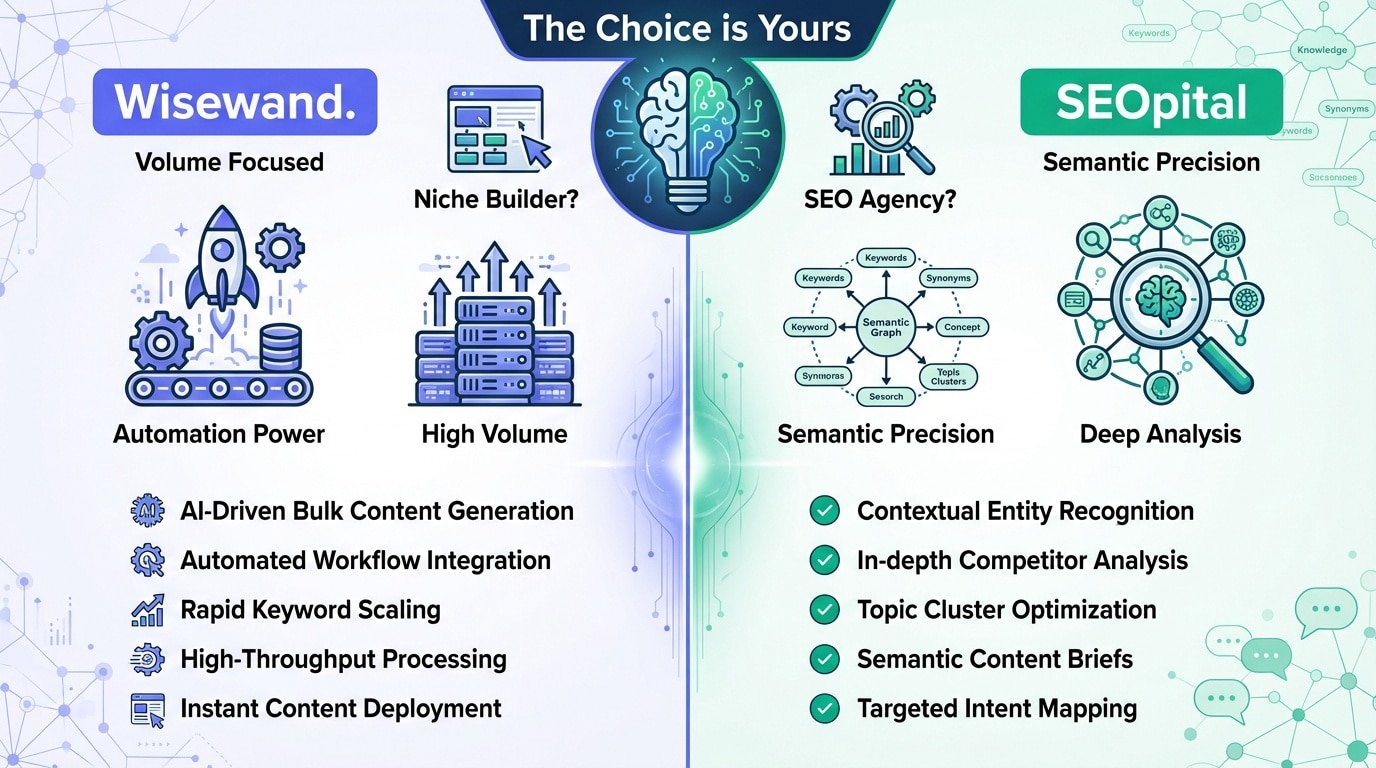
Choosing between these two French powerhouses is a headache. Wisewand prioritizes high-volume affiliate success and human-like flow, while SEOpital focuses on deep semantic precision through competitive SERP analysis.
Your choice depends on your business model. Are you an affiliate niche builder or a data-driven SEO agency?
Both tools have distinct strengths. There is no one-size-fits-all solution for your content strategy.
Let’s look at the facts. Here is a breakdown of their core capabilities.
Wisewand: The All-in-One Suite for Niche Sites
Wisewand acts as a true powerhouse for affiliate marketers by managing the entire workflow. From deep research to final publication, it streamlines every step. The goal is achieving high speed without losing your specific affiliate edge. It feels like a complete ecosystem for site owners.
The user experience is clearly designed for those who need to scale fast. Even with many advanced features, the interface stays clean and intuitive. You won’t feel overwhelmed while growing your portfolio.
Everything is integrated into one place. In fact, you don’t need five different subscriptions anymore to run your business effectively.
The tool prioritizes monetization above all else. Every single feature aims to help you earn those commissions much faster than before.
SEOpital: The Specialist for Semantic Keyword Clustering
Wisewand excels at versatile automation, but SEOpital adopts a different surgical approach. This software focuses on pure semantic depth. It doesn’t just write; it maps your entire topical authority for SEO purists. 🎯
Its clustering logic groups your keywords by real intent rather than simple volume. This allows you to build solid content silos. You thus avoid any unnecessary cannibalization on your site.
The tool relies on concrete data by analyzing current SERPs. It observes what is performing now to guarantee maximum relevance. 📊
The textual result is impressively natural. You would swear a human took up the pen for each generated paragraph.
Everything is designed to please Google’s algorithms. Ranking remains the final goal of each semantic optimization.
Features of Wisewand and SEOpital
Moving from the general philosophy of the tools to the actual « under the hood » features that make them work is essential to understand their true value. While both aim for SEO dominance, their technical toolkits cater to very different strategies.
Wisewand’s Specialized Affiliate and Autopilot Modes
Wisewand offers a dedicated affiliate mode. It creates product reviews that actually convert readers. This mode generates structured sections like pros and cons or price analyses. It focuses on turning traffic into actual commissions.
The autopilot feature is a major asset. It allows for massive content drops with minimal clicks. This is perfect for building niche empires quickly. You can manage multiple sites within distinct projects easily.
Visuals are handled by 4K image generation. High-quality visuals are added automatically. This saves hours of manual searching and editing. Every image includes optimized filenames and alt tags for SEO.
The internal linking system is quite advanced. It connects your new posts to existing ones. This builds a strong site structure without manual effort. It ensures your authority grows across the entire domain.
- Affiliate review templates
- Autopilot scheduling
- 4K AI images
- Automated internal links
SEOpital’s Keyword Clustering and GSC Integration
SEOpital excels with its clustering tool. It organizes your keywords into logical silos. This prevents keyword cannibalization across your site. It ensures each page targets a specific search intent clearly.
The Google Search Console integration is a key highlight. You can track how your generated content performs in real-time. It’s a data loop for optimization. This helps identify hidden opportunities directly from Google’s data.
SERP analysis is core to their process. The tool scans the top results to find « missing » semantic entities. This ensures your content is better than the competition. It uses real-time data to build optimized outlines.
The duplicate content checker provides extra security. It ensures every piece is unique and safe from penalties. This provides peace of mind for long-term projects. It’s a vital safeguard for maintaining site health.
Wisewand vs SEOpital: What About the Cost?
Comparing the two, Wisewand uses a flexible credit system starting around $37 monthly, while SEOpital begins at $50. You will find that Wisewand generally offers a lower cost per article, often estimated near $1 or less. SEOpital relies on fixed monthly tiers based on article volume.
Is it worth it? Saving 40% of your time on marketing texts makes these tools a steal compared to manual writing. You get high-quality SEO output for a fraction of a freelancer’s fee.
| Tool | Pricing Model | Best For | Cost-Per-Article |
|---|---|---|---|
| Wisewand | Subscription vs Credits | Affiliate vs SEO | Estimated $0.58 – $1.00 |
| SEOpital | Usage-based Tiers | Keyword Clustering | Estimated $2.50 – $5.00 |
| Comparison | Flexible vs Fixed | ROI vs Volume | Wisewand is cheaper |
Customer Reviews and Real User Feedback
Moving from numbers and prices to the actual human experience of using these platforms reveals quite a bit about their daily utility.
Feedback on Wisewand is glowing, especially regarding its « set and forget » efficiency. Portfolio owners appreciate the extreme speed of the V2, often generating high-quality articles in under three minutes.
Users of SEOpital frequently praise the « human » feel of the generated text. The community and technical support are also noted as helpful points for those focusing on semantic optimization and clusters.
However, no tool is perfect. Some users find the learning curve varied, and SEOpital’s credit system can occasionally feel a bit confusing for newcomers.
Should You Buy Wisewand or SEOpital?
For affiliate marketers, the choice is clear: go with Wisewand. Its dedicated mode for product reviews and automated WordPress publishing fits your specific workflow perfectly. It simply handles the heavy lifting.
If you are an SEO specialist focused on semantic perfection, SEOpital is your winner. Its clustering features and topical authority tools make it a true surgeon’s tool for ranking. It excels at structure.
Still undecided? Testing both is often the best way. Most offer a trial or small credit pack to see the results yourself.
Choosing between Wisewand and SEOpital depends on your goals: pick Wisewand for rapid affiliate automation and 4K images, or SEOpital for deep semantic clustering. Start your trial today to scale your rankings and secure your digital future. High-quality content is just one click away!
FAQ
Is Wisewand or SEOpital better for affiliate marketing?
If you are building niche sites or an affiliate empire, Wisewand is the clear winner here. It features a dedicated « Affiliate Mode » specifically designed to create product reviews, comparisons, and promo code pages that actually convert. It even handles your affiliate links and generates high-quality 4K images to make your content pop.
On the other hand, SEOpital lacks a specialized affiliate mode. While it is great for standard SEO articles, it doesn’t offer the same « out-of-the-box » tools for monetization that Wisewand provides to help you earn commissions faster.
Which tool offers more affordable pricing for SEO content?
When looking at the bottom line, Wisewand is generally more budget-friendly. Its entry-level plan starts at around $37 per month (billed annually), giving you roughly 23 articles. This brings the cost per article down significantly compared to SEOpital, where the starting price is estimated at $50 per month.
Wisewand also uses a credit system where credits never expire, even if you cancel your subscription. SEOpital’s pricing structure is often described as a bit more complex, making Wisewand the more flexible and transparent choice for most users.
Does SEOpital or Wisewand help more with keyword organization?
This is where SEOpital really shines. It includes a powerful keyword clustering feature that organizes your terms into logical silos. This is a huge plus for SEO purists who want to map out their entire topical authority and avoid keyword cannibalization from the start.
Wisewand focuses more on the actual writing and « humanizing » of the text. While it is excellent at producing high-quality, rankable content, it currently lacks a native keyword clustering tool. If your priority is deep semantic research and organization, SEOpital has the edge.
Can these tools automatically publish content to WordPress?
Yes, both tools offer WordPress integration to save you from the « copy-paste » nightmare. You can generate your articles and push them directly to your blog with just one click. This includes managing your metadata and SEO tags automatically.
Wisewand goes a step further by offering an « Autopilot » mode for massive content drops and an advanced internal linking system. This means it doesn’t just post the article; it also connects it to your existing content to strengthen your site structure without you lifting a finger.
Which AI tool produces more « human-sounding » content?
Wisewand puts a lot of emphasis on its « humanization » technology. It uses advanced NLP to ensure the output is often undetectable by AI detectors. Plus, you can create custom personas to mimic a specific writing style, making the text feel much less robotic.
SEOpital also produces high-quality content based on real SERP data to avoid « hallucinations, » but it lacks a specific humanization toggle. While both write well, Wisewand is the better choice if you are worried about your content sounding too much like a machine.
